

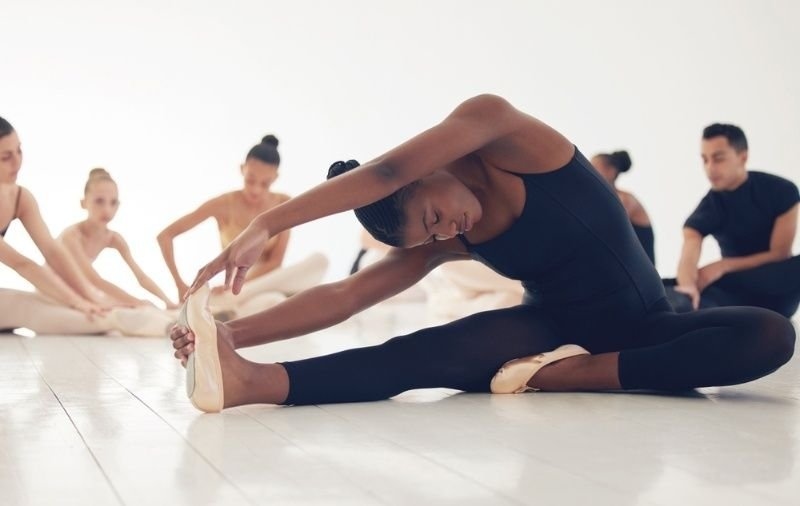
Ballet makes it look easy on stage, but it's really hard work. Dancers should have strong legs, controlled feet, relatively immobile hips, mobile ankles, and a body core to serve as the foundation for the rest of the body. A studio is not needed for each component of this work. A small space, wall, or chair and consistent practice can be adequate.
Ballet exercises at home are not about doing trickier ballet moves. They help develop the physical attributes that make ballet cleaner, safer, and more controlled. In this blog, we'll explore some easy ballet dancer strength, balance, mobility, and grace exercises to do at home.
The best ballet dancer exercises should train several things at once. Think posture, foot control, leg strength, core stability, and balance rather than simply trying to make the workout harder.
A useful home session can include:
| Exercise | Main Focus | Suggested Work |
|---|---|---|
| Calf Raises | Feet and calves | 2–3 sets of 12–15 |
| Demi Squats | Thighs and hips | 2–3 sets of 10–12 |
| Single-Leg Balance | Stability | 30 seconds each side |
| Glute Bridges | Glutes and core | 2–3 sets of 12 |
| Side Leg Lifts | Hip control | 2 sets of 12 each side |
These movements are simple, but that is partly the point. Ballet dancer exercises work best when control stays high. A rushed repetition gives you less useful practice than a slow, properly aligned one.
Strong feet are a major part of ballet technique. Start with slow rises onto the balls of the feet while keeping the weight distributed evenly across the foot. Lower with the same control.
These ballet exercises can also include toe articulations, ankle circles, and gentle arch-strengthening movements. Avoid gripping the floor with your toes. The foot should work without becoming tense.
Also Read: Dance Warm-Up Exercises for Safe Body Prep Each Session
A practical ballerina workout does not need to look like a dance class. It can combine strength drills with controlled movements that challenge posture and balance.
Try this short sequence after warming up: 12 demi squats, 12 glute bridges, 10 slow calf raises, 10 side leg lifts per side, then 30 seconds of single-leg balance per leg. Repeat for two rounds initially.
The purpose of this ballerina workout is control, not exhaustion. Keep the torso quiet while the legs move. If your balance disappears halfway through, slow down instead of forcing more repetitions.
A useful ballet workout should support technique instead of turning every session into a cardio challenge. Ballet requires strength that can be held and controlled, especially around the hips, thighs, feet, and trunk.
Core work does not need dozens of crunches. Dead bugs, forearm planks, and controlled bird dogs can help build stability while keeping the movement simple.
During a ballet workout, think about keeping the ribs and pelvis organized rather than squeezing every muscle at once. Good core control makes balances and leg movements feel less chaotic.
Don't Miss: Stretching for Dancers: Build Flexibility and Prevent Injury
The most useful exercises for dancers often expose small weaknesses. Single-leg work is one example. Stand near a wall, lift one foot slightly, and maintain your position without collapsing into the standing hip.
Use these exercises for dancers to build control:
These exercises for dancers are useful because they reveal differences between the two sides. One leg may feel steady while the other wobbles. That information is worth noticing.
Dancer strength training is not about lifting the heaviest possible load. Ballet needs usable strength—strength that can support movement without making the body rigid.
Glute bridges, split squats, calf raises, wall sits, and controlled side leg lifts are practical choices. They can be done with body weight first; resistance bands can be added later.
For dancer strength training, quality matters more than quantity. A controlled split squat with stable alignment is more useful than twenty rushed repetitions.
Try dead bugs and bird dogs alongside upper-back work such as prone arm lifts. These movements train the trunk to stay organized while the limbs move independently.
That is useful dancer strength training because ballet rarely asks the whole body to move as one stiff unit. Stability has to coexist with movement.
Suggested Reading: The Role of Rhythm and Timing in Dance for Better Movement
When practised regularly and judiciously, home practice can be of benefit in developing a solid base of skill. The aim of ballet dancers' exercises is not to create an effective ballet studio within an instant. To build muscle strength and endurance of feet, legs, hip area and core, along with muscle control and awareness. Take ballet exercises for footwork and mobility, a ballerina workout for full body control, exercises for dancers to balance, and then dancer strength training for you to use power.
Though some ballet exercises can help you balance, control your ankles, remember your posture, and aid with stability on one foot – all of which are very helpful for runners as well.
It takes a lot of intensive ballet work for beginners to do on a daily basis. Having two or three sessions where they focus on the same exercise can be helpful for repetition without being overwhelming for recovery.
Ballet can have a positive impact on active mobility, as many movements involve being able to move in a controlled range of motion. There are, however, a number of variables depending upon the flexibility.
Consider taking a light meal or snack just before training that's loaded with carbohydrates and includes a little protein. This may vary depending on someone and the length of the session. Don't exercise vigorously right after a heavy meal.
A focused session is approximately 30 to 35 minutes (warm-up and cool-down). It is easy to begin on the shorter side. This is about consistency, technique, and progression, rather than the length of sessions.
This content was created by AI